
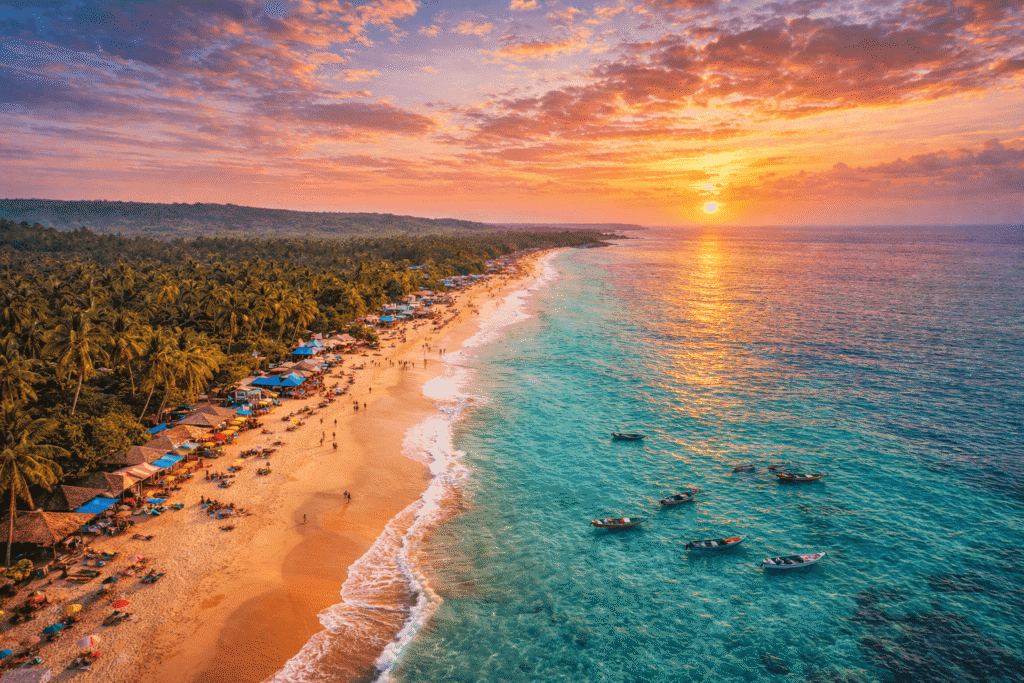
Goa doesn’t ease you in gently. The moment you step off the plane, the warm, salt-heavy air hits you, coconut palms line every road, and the pace of life shifts noticeably — as if the entire state has collectively decided that nothing is worth rushing.
This 4 days Goa travel itinerary is designed for travelers who want to experience the real texture of Goa: the chaos and color of North Goa’s beaches, the sun-bleached walls of Portuguese forts, the quiet magic of South Goa’s shoreline, and the kind of cafes where you can sit for three hours and nobody will ask you to leave.
Quick Trip Summary
| Duration | 4 Days |
| Best For | First-time visitors |
| Covers | North Goa, South Goa & Panaji |
| Ideal Budget | ₹12,000–₹30,000 per person |
| Best Time | November–February |
4 Days Goa Travel Itinerary
Here is a quick overview of this 4 days Goa travel itinerary to help you plan each day efficiently.
| Day | Area | Main Highlights | Type |
|---|---|---|---|
| Day 1 | North Goa | Baga Beach, Calangute Beach, Anjuna Flea Market, nightlife at Tito’s Lane | Beaches & Nightlife |
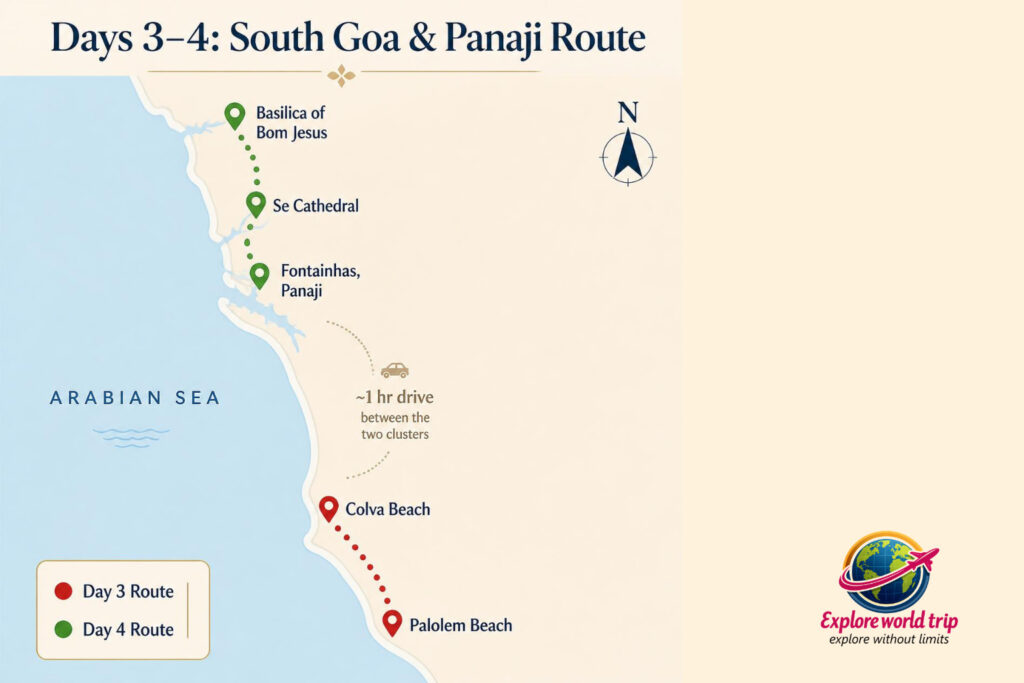
| Day 2 | North Goa | Fort Aguada, Chapora Fort, Vagator Beach, cafes in Vagator | Forts & Cafes |
| Day 3 | South Goa | Colva Beach, Palolem Beach, kayaking, dolphin spotting | Beaches & Relaxation |
| Day 4 | Panaji & Old Goa | Basilica of Bom Jesus, Se Cathedral, Fontainhas Latin Quarter, Goa markets | Culture & Heritage |
Day 1: The Living, Breathing Circus of North Goa’s Beaches
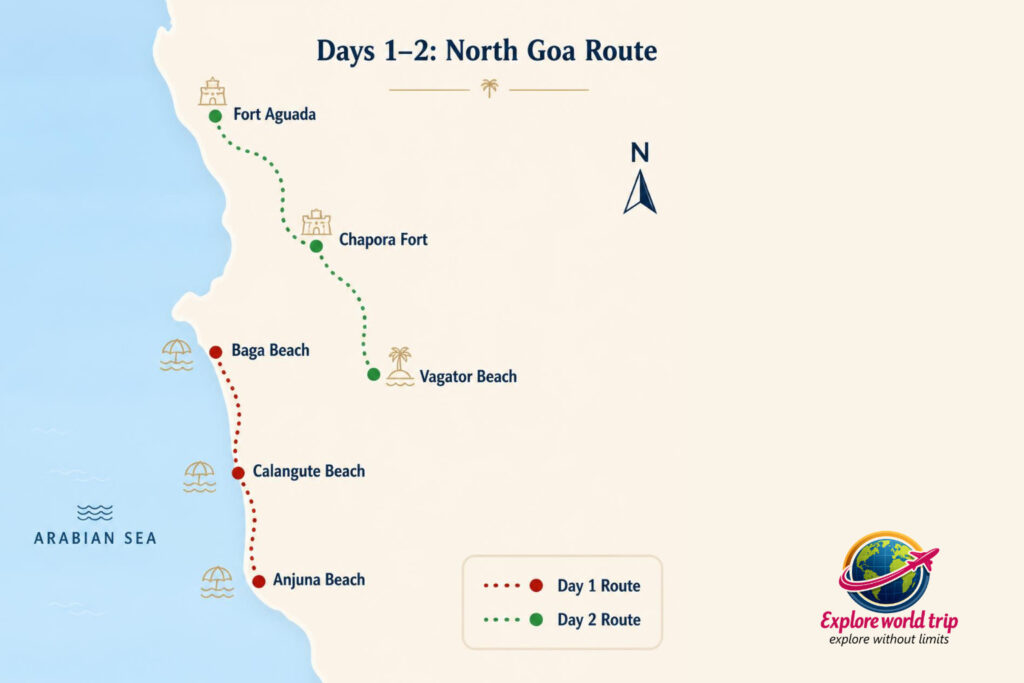
Morning: Baga and Calangute Beach
Arrive early at Baga Beach — before 8 am if you can manage it. At that hour, the beach belongs to fishermen hauling in their nets and the occasional jogger. The famous beach shacks are still shuttered, the jet skis silent, and you can actually hear the Arabian Sea. It won’t last.
By mid-morning, Baga transforms into the energetic spectacle it’s famous for: parasailing rigs launching off the sand, banana boats cutting through the shallows, vendors weaving between sunbathers with cold coconuts and friendship bracelets.
Walk north to Calangute — dubbed the “Queen of Beaches” with enough tourist enthusiasm that the nickname has stuck for decades. It’s larger, louder, and lined with everything from beachwear shops to surprisingly good restaurants.
Don’t let the commercialism put you off; the beach itself is beautiful, and the people-watching is genuinely world-class.
Afternoon: Lunch at a Beach Shack
Skip the restaurants with printed menus and laminated photos — find a beach shack instead. These open-sided, thatched-roof shacks are where Goan cooking is at its most honest.
Order the fish curry rice: a deep red, coconut-based curry with the day’s catch, served on a banana leaf or a battered tin plate with a mound of steamed rice.
Add a plate of recheado fish — whole mackerel stuffed with a fiery red masala paste and pan-fried until the skin crisps. Finish with bebinca, a layered Goan dessert made with coconut milk and egg yolks, dense and caramel-sweet.
Evening: Anjuna Beach and the Flea Market
Anjuna sits about 20 minutes from Calangute and feels like a different world. Where Baga is brash and energetic, Anjuna is rocky, atmospheric, and slightly eccentric — the kind of place that attracted backpackers in the 1970s and never fully let go of that spirit.
The rocky outcrops at the beach’s southern end make for dramatic sunset photography.
The Anjuna Flea Market, held on Wednesdays, is worth navigating even if you’re not a shopper. Tibetan traders sell silver jewelry, Rajasthani vendors display block-printed textiles, and local Goans hawk everything from hand-painted furniture to cold kingfisher beer.
Even if you buy nothing, the chaos and color is an experience in itself.
Night: Goa After Dark
Goa’s nightlife is as varied as its beaches. Tito’s Lane in Baga is the famous option — loud, crowded, and unapologetically commercial.
If that’s not your scene, the beach clubs around Anjuna and Vagator offer a more curated atmosphere, with open-air dance floors and the sea breeze keeping things comfortable well past midnight.
Or simply find a beach bar, order a feni (Goa’s local cashew spirit), and let the night take care of itself.
Day 2: Forts, Viewpoints and the Portuguese Shadow
Morning: Fort Aguada
Fort Aguada was built in 1612 at the mouth of the Mandovi River, and the Portuguese knew exactly what they were doing when they chose this headland.
From the battlements, you can see the Arabian Sea in three directions — a view that made the fort essentially impenetrable from the water.
Walk the full circuit of the outer walls before heading to the lighthouse at the top, one of the oldest in Asia, still standing in perfectly maintained condition.
Early mornings here are quiet; you’ll mostly share the space with local families and the occasional school group.
Afternoon: Chapora Fort and the View That Made a Movie Famous
Chapora Fort sits on a dramatic basalt headland above Vagator, and yes — it’s the fort from Dil Chahta Hai. But even if Bollywood means nothing to you, the view from the crumbling red-laterite walls is genuinely extraordinary.
Below lies Vagator Beach, a curving arc of dark sand framed by red cliffs, and beyond it, the open sea stretching to the horizon. The fort itself is largely ruined — no roof, no exhibits, just sun-bleached walls and wind — which somehow makes it more beautiful, not less.
Lunch: Cafes in Vagator
After the fort, walk down into Vagator village and find a table at Artjuna Cafe — a shaded garden cafe with mismatched furniture, strong filter coffee, and a menu that mixes falafel wraps with Goan fish tacos.
Bean Me Up nearby is the spot if you want something healthy: they’ve been doing excellent plant-based food long before it was fashionable.
Neither place is cheap by local standards, but both are genuinely good, and both have the kind of relaxed, nobody’s-watching-the-clock atmosphere that makes you stay longer than planned.
Evening: Vagator Beach
Return to Vagator for the evening. Unlike the busier northern beaches, the crowd here tends toward travelers who’ve been in Goa for a few days and have stopped needing to see and do everything.
The red cliffs turn a deep amber as the sun drops, and the whole beach takes on a cinematic quality. Bring a book or don’t — it doesn’t matter much either way.
Day 3: The Quiet South
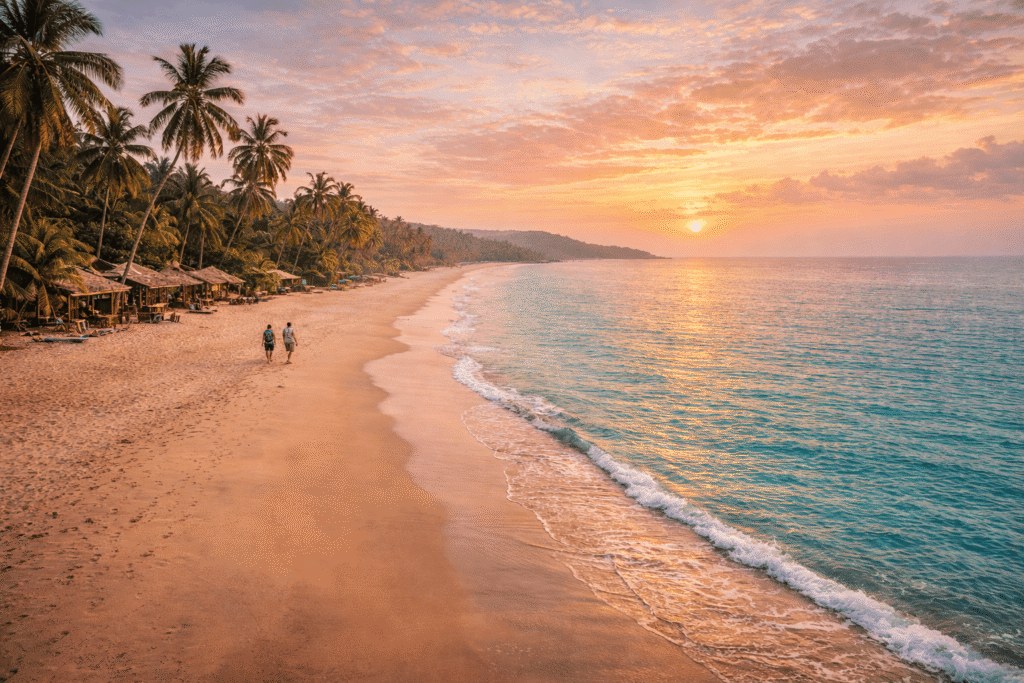
North Goa gets the attention, but South Goa is what people mean when they close their eyes and imagine Goa in a dream.
The beaches are longer, emptier and bordered by casuarina trees rather than beach shacks. The pace slows down to something close to a full stop.
Morning: Colva Beach
Colva is the South’s answer to Calangute — the main beach, the well-known one — but the comparison ends there. Colva stretches for almost 25km of unbroken coastline, and on a weekday morning you can walk for 20 minutes in either direction without passing another person.
The water is calm and clear, good for swimming in a way the rougher northern beaches sometimes aren’t. Start here with a slow breakfast from one of the small local restaurants lining the road to the beach: poee bread (Goan bread baked in palm leaves), butter, and strong chai.
Afternoon: Palolem Beach
An hour’s drive south, Palolem is where the postcard version of Goa actually exists. The beach forms a near-perfect crescent, protected at both ends by rocky headlands draped in vegetation.
The water inside this natural bay is extraordinarily calm — more like a lake than an ocean — which makes it ideal for kayaking.
Rent a kayak from one of the operators along the shore and paddle to the rocky outcrop at the southern end; on the other side, you’ll find a tiny hidden cove that most visitors never see.
The dolphin-spotting boats that leave from Palolem in the morning (if you can get there for an early start) have a genuinely high success rate — bottlenose dolphins are resident in these waters year-round.
Lunch: Beachside Dining at Palolem
Dropadi Restaurant, set back slightly from the main beach, does excellent seafood thalis — a full spread of rice, dal, vegetable curry, fish curry, papad and pickle, all arriving in small steel bowls on a round tray.
It’s the kind of meal that costs less than a coffee in most cities and leaves you completely satisfied. For something lighter, Art Resort Cafe on the beach has good salads and fresh lime soda served in a shaded spot right on the sand.
If you’re planning to stay in the area, there are several well-regarded Goa beach resorts along this stretch that combine comfort with direct beach access.
Evening: Palolem Sunset
Stay for it. Palolem’s west-facing orientation means the sunset here is unhurried and theatrical — the sky runs through orange, then deep pink, then a vivid purple before the stars appear.
It’s the kind of thing that makes you feel slightly embarrassed for not having appreciated sunsets more until now.
Day 4: Old Goa, Panaji and the Art of Leaving Slowly
Morning: Old Goa’s Churches
The churches of Old Goa are not like ordinary tourist attractions. They were built with genuine ambition and genuine faith, and that still comes through 400 years later. The Basilica of Bom Jesus holds the remains of St. Francis Xavier in an ornate silver casket — the basilica is dim and cool inside, with the smell of old stone and incense, and a quiet that feels earned.
Next door, the Se Cathedral is even larger, its single remaining tower (the other collapsed in 1776 and was never rebuilt) giving it an asymmetrical grace. Both are UNESCO World Heritage Sites, and both are best visited in the early morning before the tour groups arrive.
Afternoon: Panaji and the Fontainhas Quarter
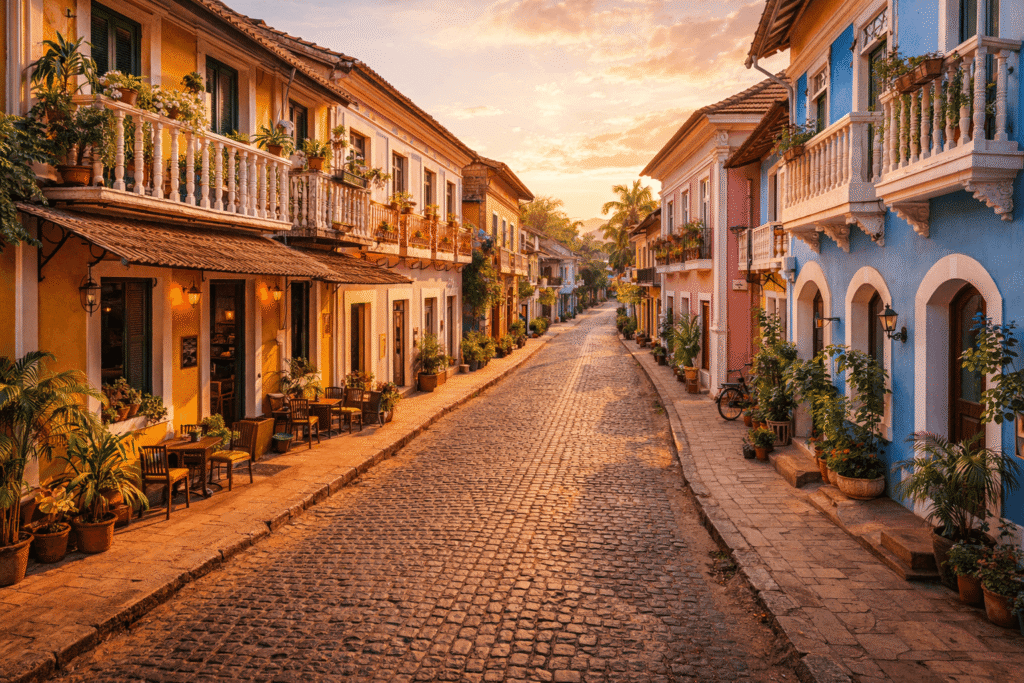
Panaji (or Panjim) is a small, navigable capital — the kind of city you can actually walk around without a map. Head straight to Fontainhas, the old Latin Quarter, where the streets are barely wide enough for a scooter and the houses are painted in mustard yellow, burnt sienna, and sea-foam green with white trim and terracotta roof tiles.
It genuinely looks like a corner of Lisbon that somehow drifted east. The art galleries here — small, independent, mostly showing Goan and Indian contemporary work — are worth wandering into even if you have no intention of buying anything.
Lunch: Panaji’s Best Tables
Cafe Bodega, set inside the courtyard of a beautifully restored colonial building, is one of the most atmospheric lunch spots in all of Goa. The food — salads, sandwiches, Goan-Portuguese fusion — is good, but the setting is better: bougainvillea overhead, old tiles underfoot, complete quiet in the middle of the city.
Ritz Classic nearby is the no-nonsense alternative: a plain room, fluorescent lighting, and absolutely outstanding Goan seafood that locals have been eating for decades.
Evening: Markets and the Art of the Last Hours
Goa’s markets reward the unhurried. The Mapusa Market (best on Fridays) is a proper local market — produce, spices, dried fish, vegetables — with a small section of handicrafts tucked toward the back.
The Anjuna Flea Market and Arpora Night Market are more tourist-oriented but genuinely enjoyable if you approach them without urgency.
Pick up Goan spice mixes (the recheado masala paste travels well), cashews (Goa produces some of India’s finest), and hand-block-printed fabric if you see something you like.
Don’t leave the last evening entirely to shopping. Goa has a way of making departure feel like a mistake. Find somewhere to sit as the light fades — a rooftop bar in Panaji, a plastic chair outside a small toddy shop, the steps of a church — and let the last hours move at whatever pace they want.
Best Time to Visit
November to February is the sweet spot — warm but not brutal, dry, and full of energy. The beaches are at their best and so are the markets and cafe scenes.
March and April are hotter and quieter, which suits some travelers perfectly. May brings pre-monsoon humidity that can feel relentless.
The monsoon (June–September) transforms Goa into something genuinely beautiful — everything intensely green, the rivers swollen, the crowds gone — but most beach activity stops, many restaurants close, and the sea is dangerous.
If you’re a photographer or just want to see a different Goa, the monsoon is underrated.
Estimated Cost for 4 Days
Costs vary widely depending on where you stay and how you get around, but here’s a realistic range per person for the full 4 days, including stay, food, local transport, and entry fees.
| Budget Type | Approx. Cost (per person) |
|---|---|
| Budget | ₹12,000–₹18,000 |
| Mid-range | ₹20,000–₹35,000 |
| Luxury | ₹45,000+ |
Budget trips typically mean hostel or guesthouse stays, scooter rentals, and eating mostly at beach shacks and local restaurants. Mid-range covers a comfortable 3-star guesthouse or resort, some paid activities like kayaking or a dolphin cruise, and the occasional nicer meal. Luxury covers beachfront resorts, private transport, and dining at places like Cafe Bodega throughout.
Practical Notes
Getting around Goa without a scooter is technically possible but slow and expensive. Rent a scooter — you don’t need an international license, the roads are manageable, and it costs roughly ₹400–500 a day. It will change your trip.
Carry cash. Most beach shacks, small restaurants, and market vendors won’t take cards. ATMs in Panaji and Calangute are reliable; those in smaller villages less so.
Go early for anything involving popular beaches or heritage sites. By 10am, the light is harsh and the crowds are thick. By 7am, Goa is still yours.
The sun is stronger than it feels. Drink more water than you think you need, use sunscreen, and if you’re on a scooter — wear a helmet, always.
Packing Essentials
A few things worth packing before you land, so you’re not hunting for them on Day 1:
- Sunscreen (reef-safe if you’re planning to snorkel or kayak)
- Sunglasses
- Flip-flops or sandals you don’t mind getting wet
- A reusable water bottle
- Light, breathable cotton clothes
- A light rain jacket if you’re travelling near the monsoon shoulder months
FAQ
Yes, 4 days are enough to explore Goa’s main highlights, including beaches, nightlife, water sports, and a bit of sightseeing. It’s ideal for a quick and well-balanced trip.
A 4-day Goa trip can cost around ₹10,000–₹25,000 per person on a budget, while mid-range trips may go up to ₹30,000–₹50,000 depending on stay and activities.
Yes, ₹50,000 is more than enough for a comfortable 4–5 day Goa trip, including good accommodation, food, local travel, and activities.
North Goa is better for nightlife, water sports, and crowds, while South Goa is ideal for peaceful beaches, luxury stays, and relaxation.
Conclusion
Goa works best when you stop trying to maximize it. This 4 days Goa travel itinerary gives you the perfect balance of lively beaches, historic forts, peaceful coastal stretches, and charming cafes that define the spirit of the state.
From the energetic shores of North Goa to the quieter landscapes of South Goa and the colonial charm of Panaji, these four days offer a memorable introduction to one of India’s most loved travel destinations.
The days that end up being most memorable — a long lunch that turns into an afternoon, a beach walked too far in the wrong direction, or a cafe discovered by accident — are rarely the ones carefully planned. Use this itinerary as a guide, but allow Goa’s relaxed rhythm to shape your journey along the way.