
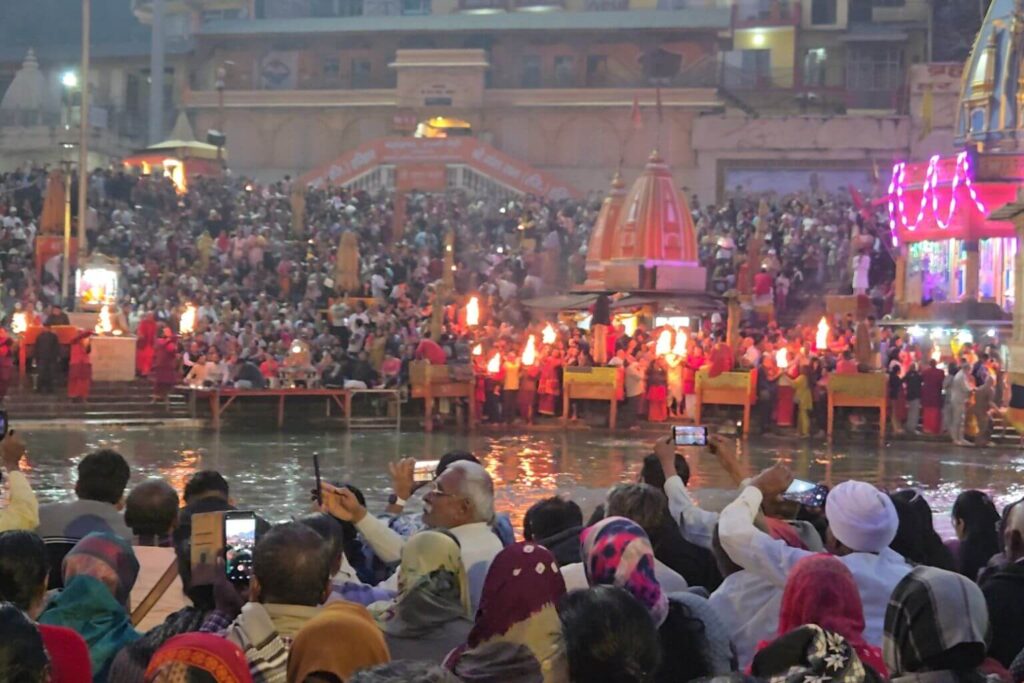
The Ganga Aarti in Haridwar is one of the most spiritually charged experiences in all of India. Every single evening, the sun dissolves behind the Shivalik hills.
Darkness begins to settle over the city. And right on cue — without fail, without exception — the ceremony begins on the banks of the Ganges.
Dozens of priests dressed in saffron robes take their positions on the ghats. They lift enormous brass lamps blazing with fire.
Ganga Aarti in Haridwar takes place twice daily at Har Ki Pauri—early morning around sunrise and evening around sunset.
The evening aarti is more popular, featuring lamps, chants, and a spiritual atmosphere attracting thousands of visitors.
Then, in perfect synchronization, they begin a ceremony that has been performed without interruption for centuries.
This is not a performance staged for tourists. It is a deeply sincere act of worship, conducted with the same devotion whether ten people are watching or ten thousand.
For anyone visiting Haridwar, missing the Ganga Aarti would be like visiting Paris and skipping the Eiffel Tower — except here, the stakes feel somehow more spiritual, more permanent.
Where Is It Held?
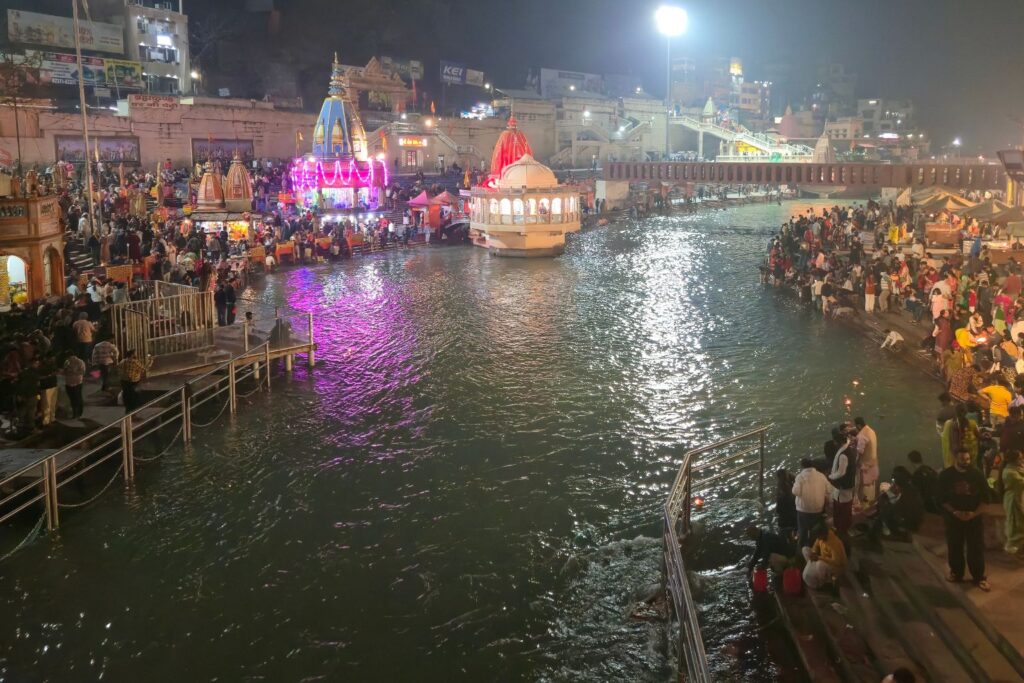
The Ganga Aarti in Haridwar takes place at Har Ki Pauri, which translates to “steps of God.”
It is considered one of the holiest ghats in all of India, believed to be the exact spot where the Ganges exits the Himalayas and enters the plains.
Har Ki Pauri sits at the heart of old Haridwar, roughly 2 km from Haridwar Railway Station. The ghat is flanked by ancient temples, dharamshalas, and the constant movement of pilgrims.
A large clock tower marks its entrance. You will hear the bells before you see it.
Secondary location: A smaller but equally atmospheric aarti also takes place at Kushavarta Ghat in Kankhal, about 4 km south of Har Ki Pauri.
It draws a far smaller crowd and offers an intimate alternative if you want a quieter experience.
Best Time to Attend
Evening Aarti (The Main Event)
The evening aarti is the one everyone comes for. The timing shifts with the seasons:
| Season | Approximate Time |
|---|---|
| Summer (April – June) | 7:00 PM – 7:30 PM |
| Monsoon (July – September) | 6:30 PM – 7:00 PM |
| Autumn (October – November) | 6:00 PM – 6:30 PM |
| Winter (December – March) | 5:30 PM – 6:00 PM |
Because the timing adjusts with sunset, always verify the exact time locally when you arrive, or ask at your hotel. You can also check with the Ganga Sabha, the religious body that organizes the ceremony.
Arrive at least 45 minutes early. The ghats fill up fast. By the time the aarti begins, prime viewing spots are long gone.
Morning Aarti
A quieter, more meditative aarti also takes place each morning at sunrise — typically around 5:30 AM to 6:00 AM, again varying by season.
The crowds are smaller, the air is cold and misty, and the atmosphere has a stillness that the evening aarti, with its crowds and energy, cannot replicate. For serious seekers, the morning aarti is arguably the more moving experience.
If you’re staying longer, follow this 3-day Rishikesh itinerary for a complete trip plan.
What Happens During the Aarti
The ceremony lasts roughly 45 minutes to an hour. Here is what unfolds:
The priests — typically young men trained in Vedic tradition — begin by lighting the massive multi-tiered lamps called deepams or aarti thalis.
These are not small candles. They are towering structures of fire, sometimes with dozens of wicks burning simultaneously.
As the lamps are lit, the chanting begins. The air fills with Sanskrit hymns — Om Jai Gange Mata being the most recognizable — accompanied by conch shells, bells, and drums. The sound builds until it seems to vibrate in your chest.
The priests then perform circular movements with the lamps in perfect synchronization, tracing spirals of fire in the darkening air. The flames reflect off the moving water below, creating a double image of light — one in the air, one in the river.
At key moments, thousands of small clay lamps (diyas) are floated onto the river by devotees.
These little lights drift slowly downstream, each one carrying a wish, a prayer, or an offering. Watching hundreds of tiny flames float away into the dark is one of those sights that stays with you.
The ceremony concludes with distribution of prasad — sacred food — and the crowd slowly disperses, though many linger on the steps, reluctant to leave.
How to Get the Best Experience
Position Yourself Well
The elevated viewing area on the right bank (as you face the river) gives a panoramic view of the entire ghat.
The stone steps closest to the priests are the most immersive — you can feel the heat of the lamps and the spray of the river — but they fill up earliest. Arrive an hour before the aarti starts if you want them.
Leave Your Shoes Early
Footwear is not permitted on the ghat. There are shoe deposit counters nearby for a nominal fee. Wearing slip-on shoes makes this significantly easier.
Bring Cash for the Diyas
Local vendors sell small leaf boats with diyas and flowers for ₹10–₹50. Floating one on the Ganga during the aarti is a simple, beautiful act that needs no religious belief to feel meaningful.
Put the Phone Down (Sometimes)
It is tempting to photograph everything. Do photograph it — the visuals are extraordinary. But set aside a few minutes where you simply watch, listen, and absorb. The ceremony rewards full attention.
Dress Modestly
This is an active place of worship. Covered shoulders and legs are appropriate. A light shawl or dupatta is useful both for modesty and warmth, especially in winter evenings.
How to Reach Har Ki Pauri
By Train: Haridwar Railway Station is well connected to Delhi, Dehradun, Rishikesh, and most major North Indian cities. From the station, Har Ki Pauri is a 15–20 minute walk or a short auto-rickshaw ride (₹30–₹50).
By Road: Haridwar is 220 km from Delhi (approx. 5–6 hours), 55 km from Rishikesh (1 hour), and 50 km from Dehradun (1 hour). Buses run frequently from all three. Private taxis are readily available.
By Air: The nearest airport is Jolly Grant Airport in Dehradun, about 35 km away. Taxis to Haridwar from the airport cost ₹800–₹1,200.
Local transport: Within Haridwar, auto-rickshaws and e-rickshaws are the easiest way to get around. Har Ki Pauri is closed to vehicles, so you will walk the last stretch regardless.
For exact distances and travel options, check Rishikesh to Haridwar distance & travel guide.
Best Time of Year to Visit Haridwar
While the Ganga Aarti in Haridwar happens every single day of the year without exception, some seasons offer a richer experience than others:
October to February is considered the best period. The weather is cool and pleasant, the air is clear, and the post-monsoon Ganges runs clean and blue-green. Winter evenings at the aarti, with cold air and blazing lamps, are particularly powerful.
March and April bring large pilgrimage crowds, especially around festivals like Mahashivaratri and the beginning of the Char Dham Yatra season. The energy is electric but the crowds are intense.
May and June are hot — temperatures regularly cross 40°C — but the aarti continues regardless, and fewer tourists mean a more local experience.
July to September (Monsoon) brings heavy rains and the Ganges swells considerably. Flooding occasionally affects the lower steps. The aarti continues, and there is something primally atmospheric about watching it in the rain, but logistics are harder.
Kumbh Mela years (the next Ardh Kumbh is in 2027) draw tens of millions of pilgrims to Haridwar.
The Ganga Aarti in Haridwar during Kumbh is an overwhelming, once-in-a-lifetime spectacle — but requires significant advance planning for accommodation.
Practical Tips at a Glance
- Photography: Allowed freely on the ghats. For close-up shots of the priests, some ask for a small donation — ₹20–₹50 is appropriate.
- Crowds: Weekends and Hindu festivals draw significantly larger crowds. If you prefer space, visit on a weekday.
- Security: The ghat area has police and security personnel. Keep your belongings close — pickpocketing does occur in dense crowds.
- Mobile signal: It can be weak during peak aarti hours due to the volume of people. Download offline maps in advance.
- Accommodation: Book ahead, especially during October–November and any major Hindu festival. Hotels within walking distance of Har Ki Pauri are in high demand.
- Bathing: Pilgrims bathe in the Ganges before the aarti. If you wish to take a dip, the designated bathing ghats adjacent to Har Ki Pauri have changing rooms and lockers.
FAQ
The morning Ganga Aarti at Har Ki Pauri usually takes place between 5:30 AM and 6:30 AM, depending on the season. It is a peaceful experience with fewer crowds, making it ideal for those seeking a calm spiritual atmosphere.
The Ganga Aarti in Haridwar is performed at Har Ki Pauri, the most sacred ghat along the Ganges River. This is the main location where thousands of devotees gather every evening to witness the ritual.
The evening Ganga Aarti in Haridwar generally takes place at:
Summer (April–October): 6:30 PM – 7:00 PM
Winter (November–March): 5:30 PM – 6:00 PM
👉 The exact timing may vary slightly based on sunset.
In Rishikesh, Ganga Aarti is held at two main locations:
Parmarth Niketan Ashram: Around 5:30 PM – 6:30 PM (winter) and 6:00 PM – 7:00 PM (summer)
Triveni Ghat: Around 6:00 PM – 7:00 PM
👉 Parmarth Niketan is the most popular and offers a more organized spiritual experience.
Conclusion
The Ganga Aarti is a religious ceremony, not a cultural show. Thousands of the people around you are pilgrims who have traveled days to be there, some on the most important spiritual journey of their lives.
Moving through the crowd with patience, refraining from loud conversation during the ceremony, and observing the rituals quietly all matter — not as rules, but as basic human courtesy.
Whatever your personal beliefs, the Ganga Aarti in Haridwar offers something rare: a moment of collective stillness, of fire meeting water, of ancient sound filling a modern night. It is one of those experiences that earns the word unforgettable.
Best time to visit: October–February | Location: Har Ki Pauri, Haridwar | Aarti time: Varies with sunset — confirm locally | Entry: Free